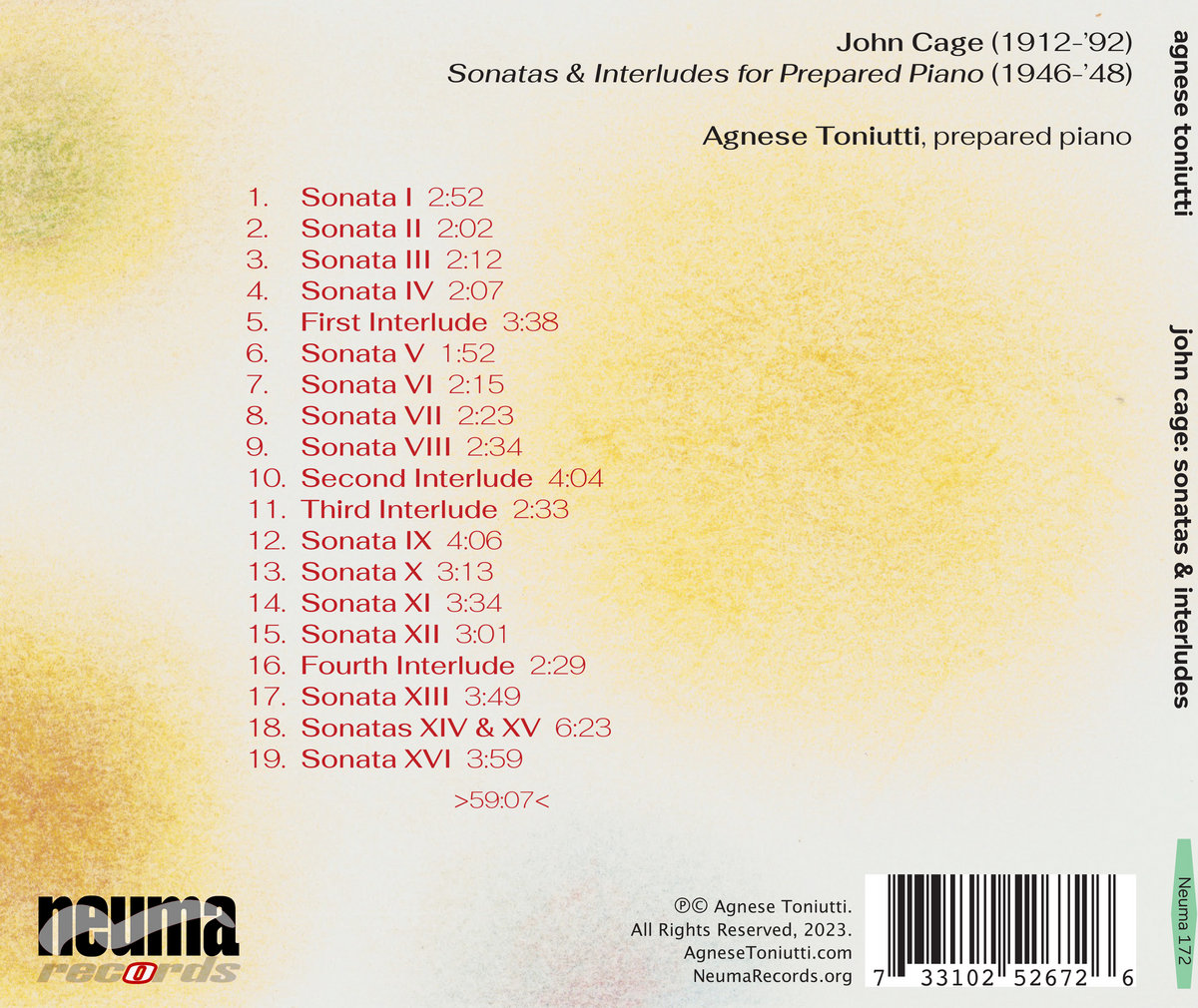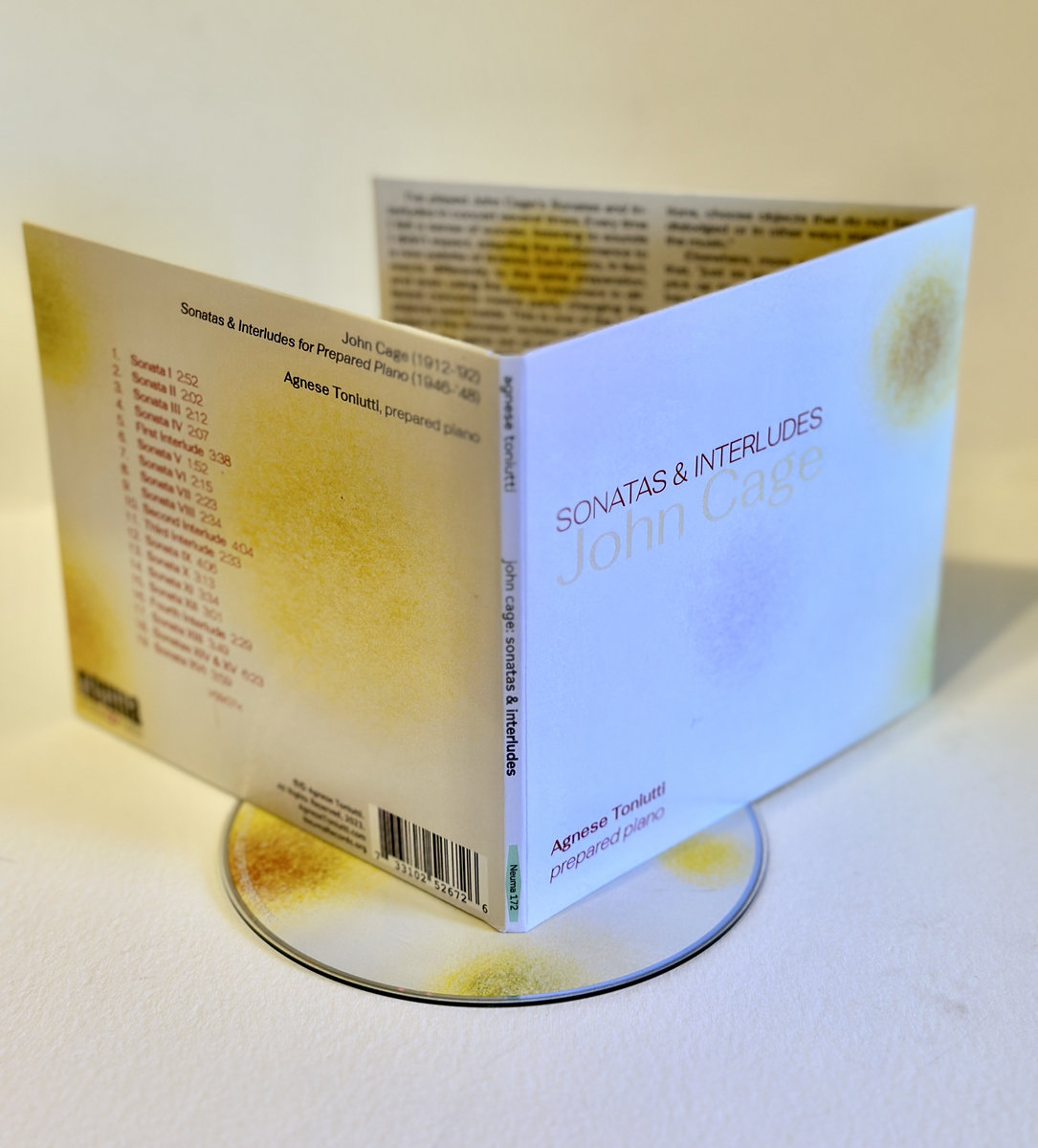
Some discovers from the web, “old” and new. Happy to start the new year being included in critic João Esteves da Silva’s favourite albums of 2023 with John Cage’s Sonatas&Interludes for prepared piano (Neuma Records, 2023).
And, again from the year just passed, here is an interview by critic Guido Michelone for Doppio Jazz. Guido attended my lecture-concert on extended piano techniques in July, for festival UdineJazz, and then asked me an interview. Of course I dare not claim any say in jazz, I’m just partecipating as a “curious of sounds”, as the title says!
This Saturday, 9th December, the new release of John Cage’s Sonatas&Interludes for prepared piano (Neuma Records, 2023) will be presented in Trieste, Italy, h. 19.00 at Revoltella Museum, invited by Trieste Prima Festival. The conversation around Cage will be accompanied by the young pianists of Piano City Pordenone; a dialogue between Cage’s music for prepared piano and works by Ligeti, Kurtàg e Dohnányi. From the booklet of the festival: “Will we also find the suggestions inherent in Sonatas & Interludes in Kurtagian hommages and Ligeti’s piano pages? Or will it be the seemingly most distant piece, Dohnányi’s Nocturne, that is most in tune with the Cagean dimension?“…
This month a couple of news related in some way to the hot topic of the moment, Artificial Intelligence and its connection to the most human of human characteristics, art making.
Finally out the trailer of the multimedia installation The moon is full, but it is not the moon, which took place in Luxembourg last summer. Together with artists Gioj De Marco, Karolina Pernar and Andrej Mircev, we dreamt our dreams and fed an AI, interacting through and with it to build a collective dreamworld. This was the base for our artistic output that took the form of an immersive multimedia installation. Here you can have a taste of it:
This experience is still working in my mind; what AI means and can mean for our present and future… (no easy pronouncements on such a complex topic).
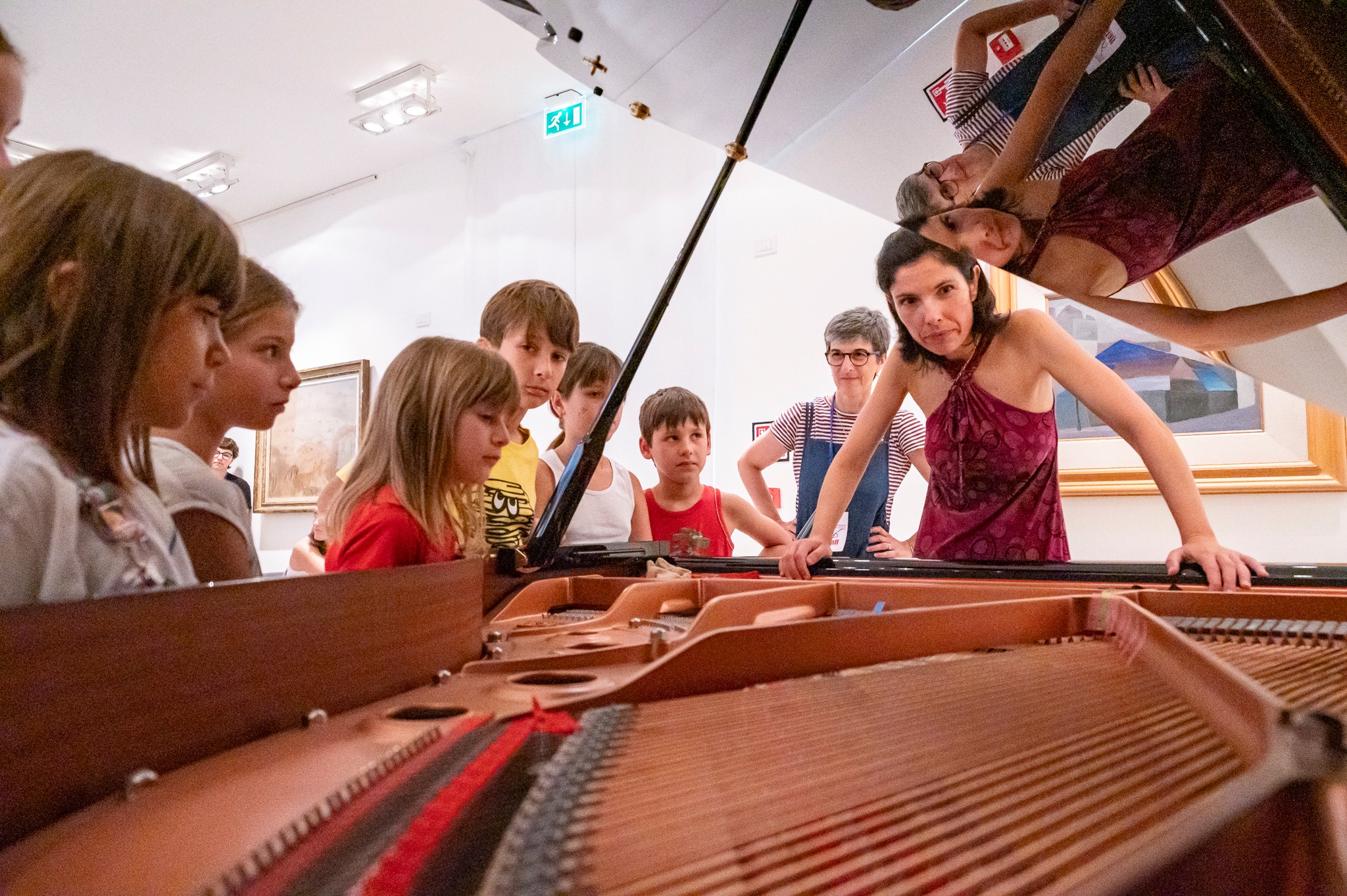
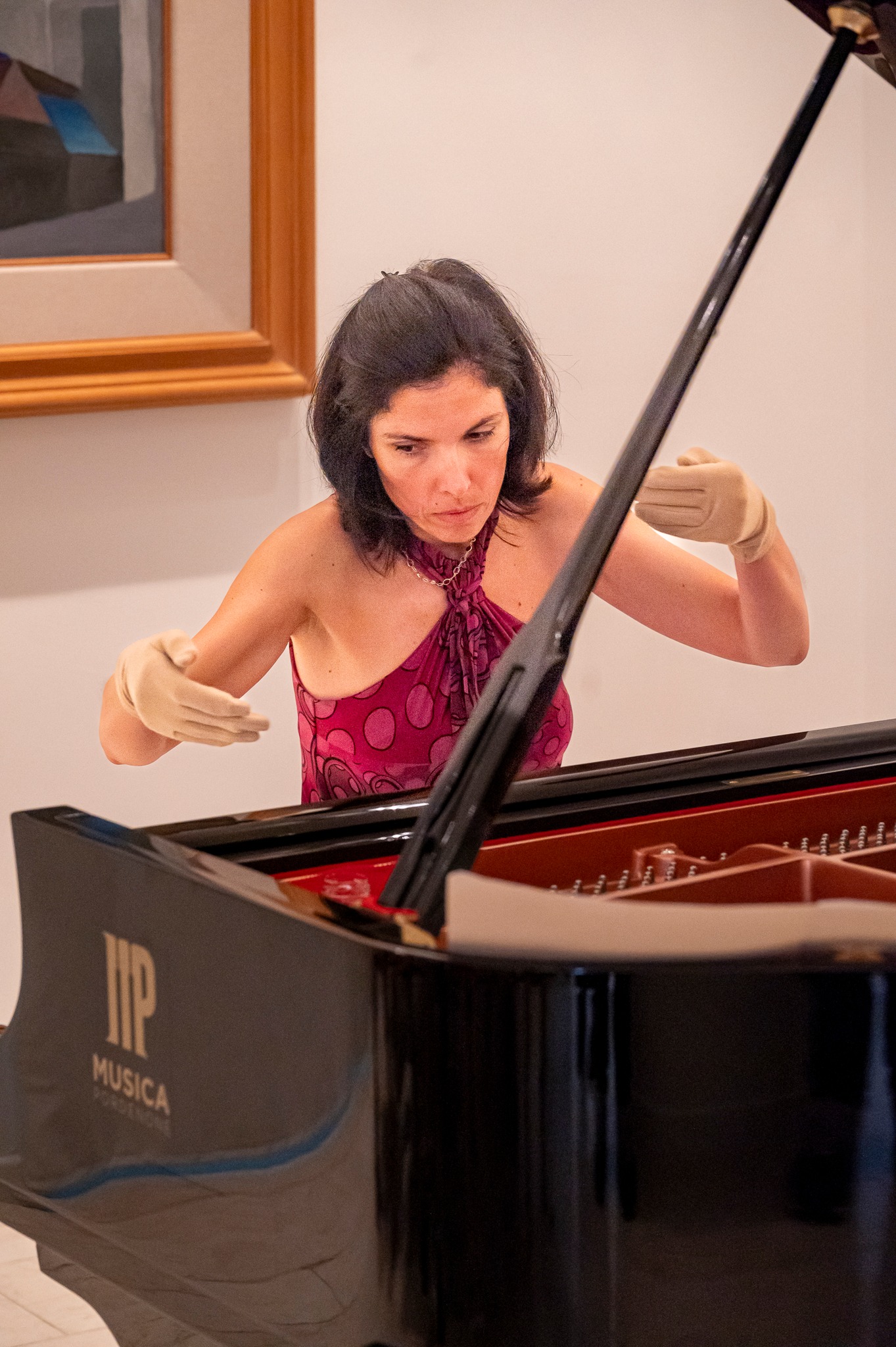
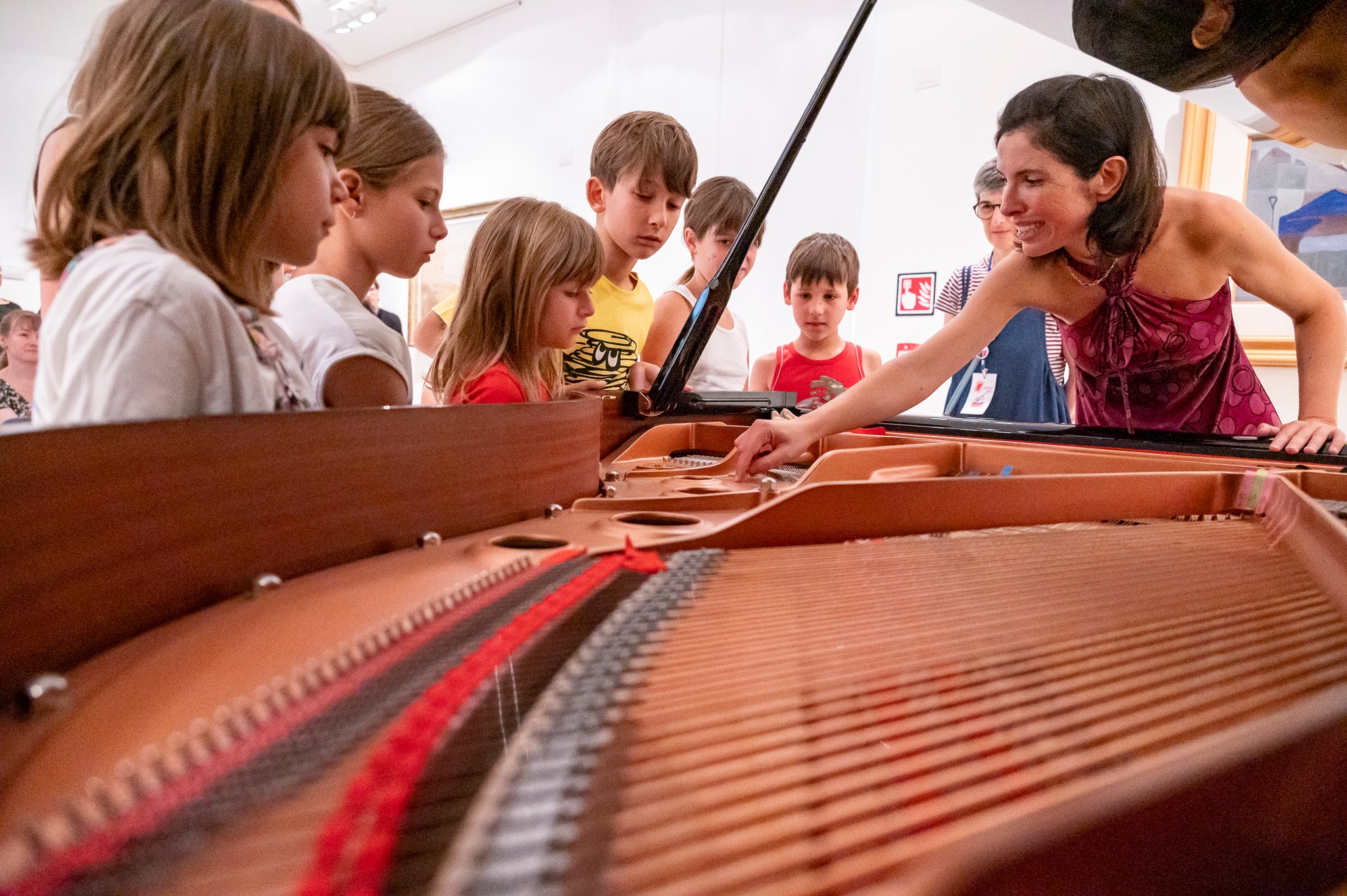
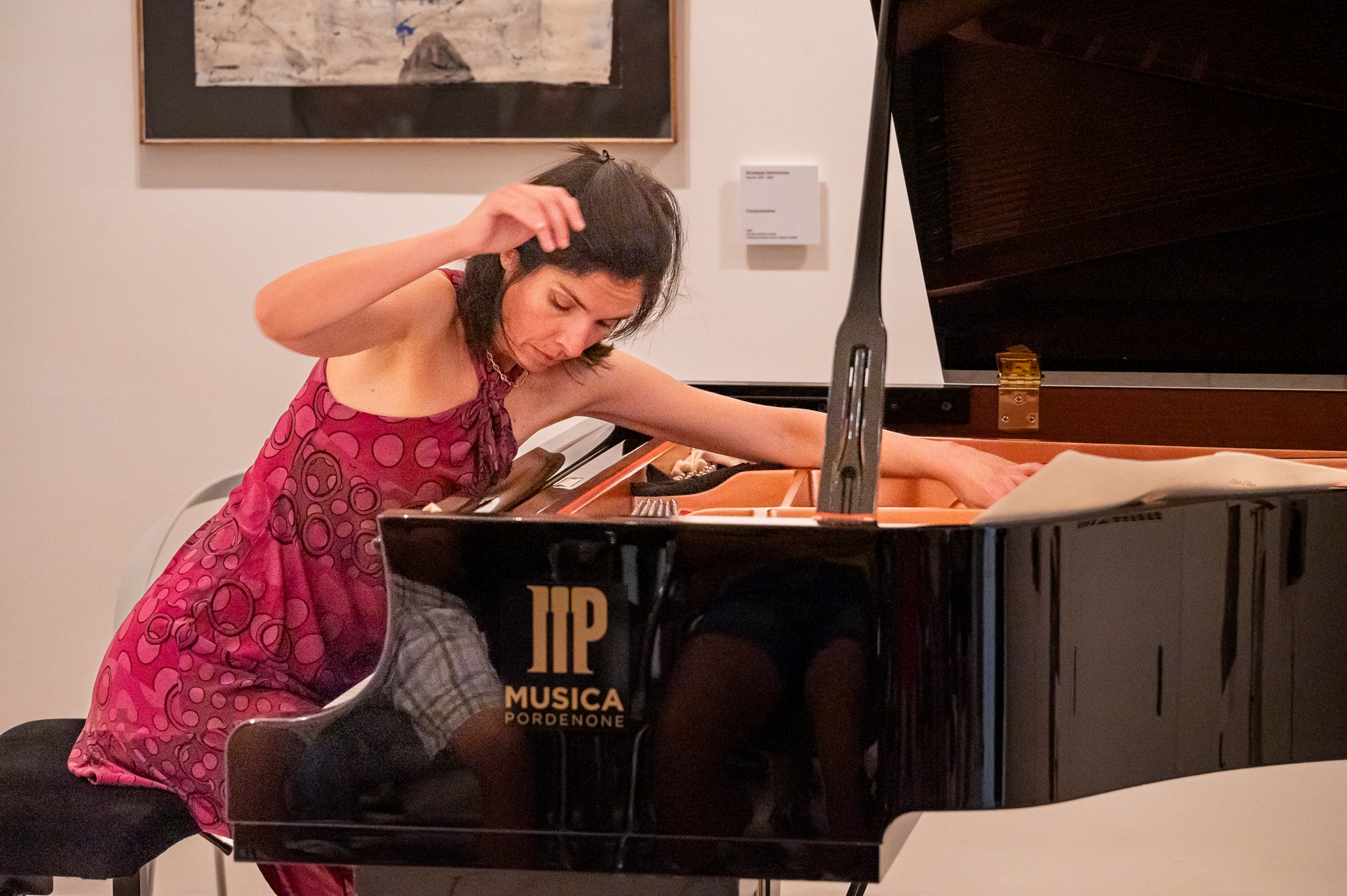
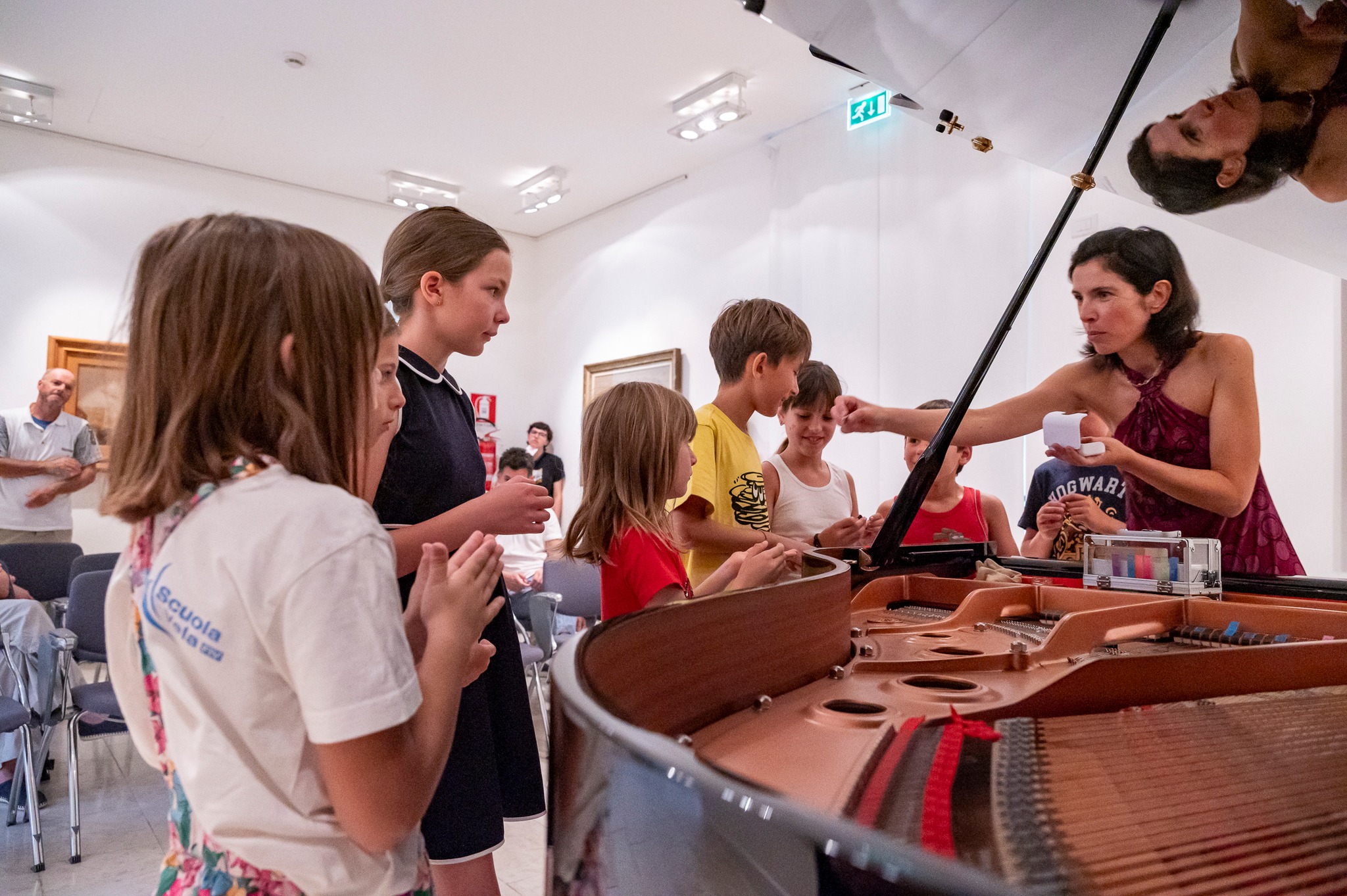
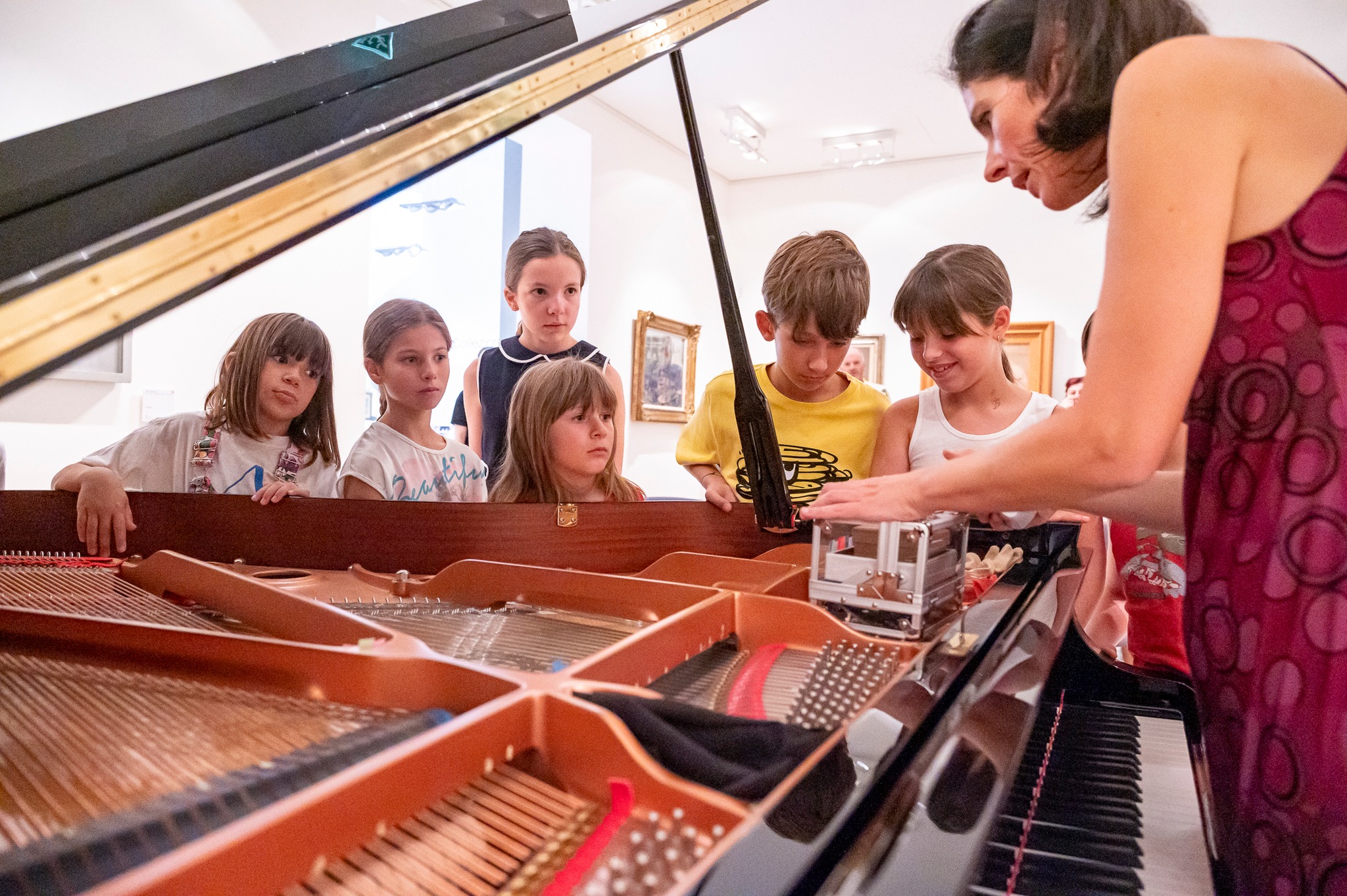
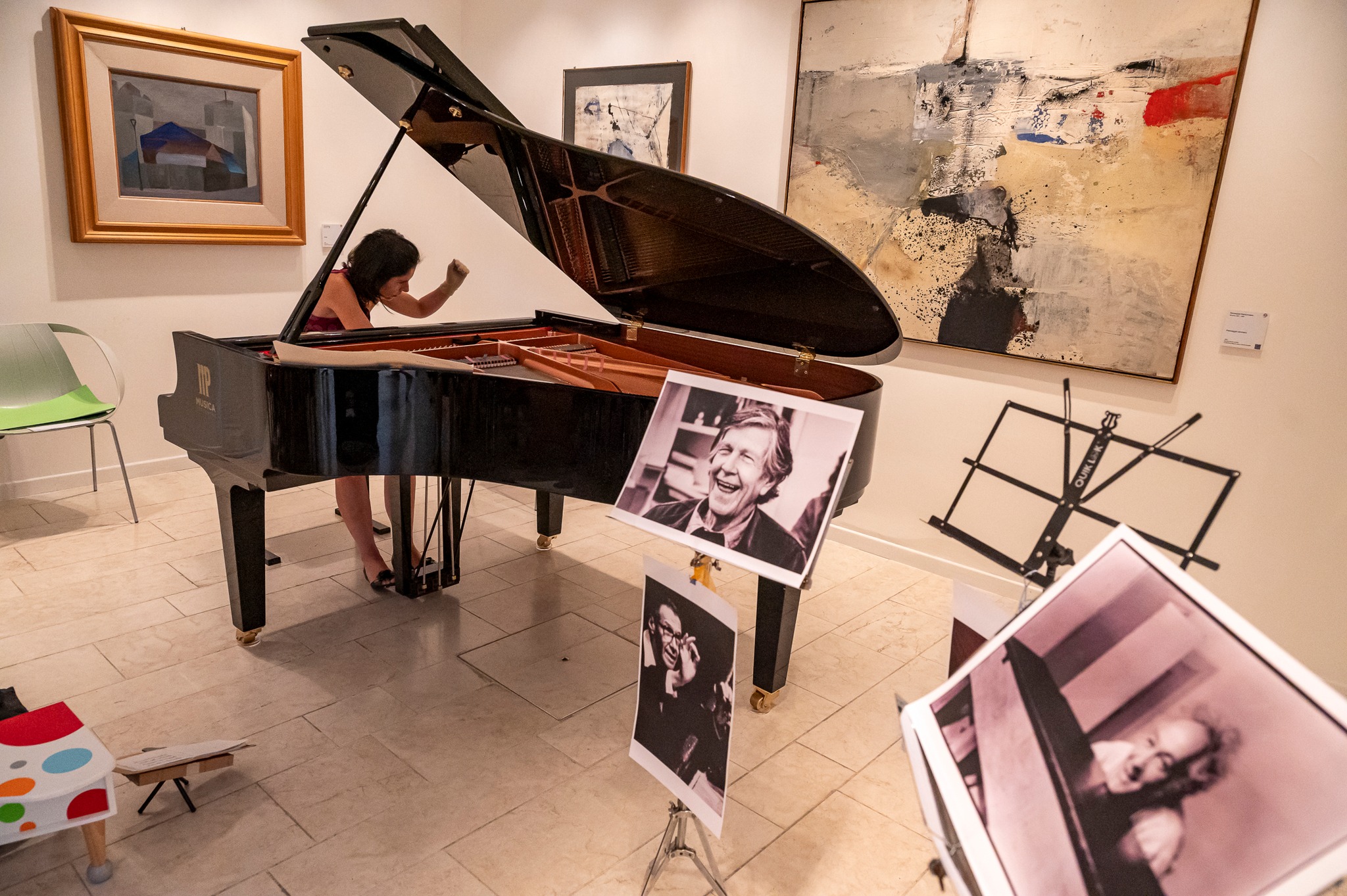
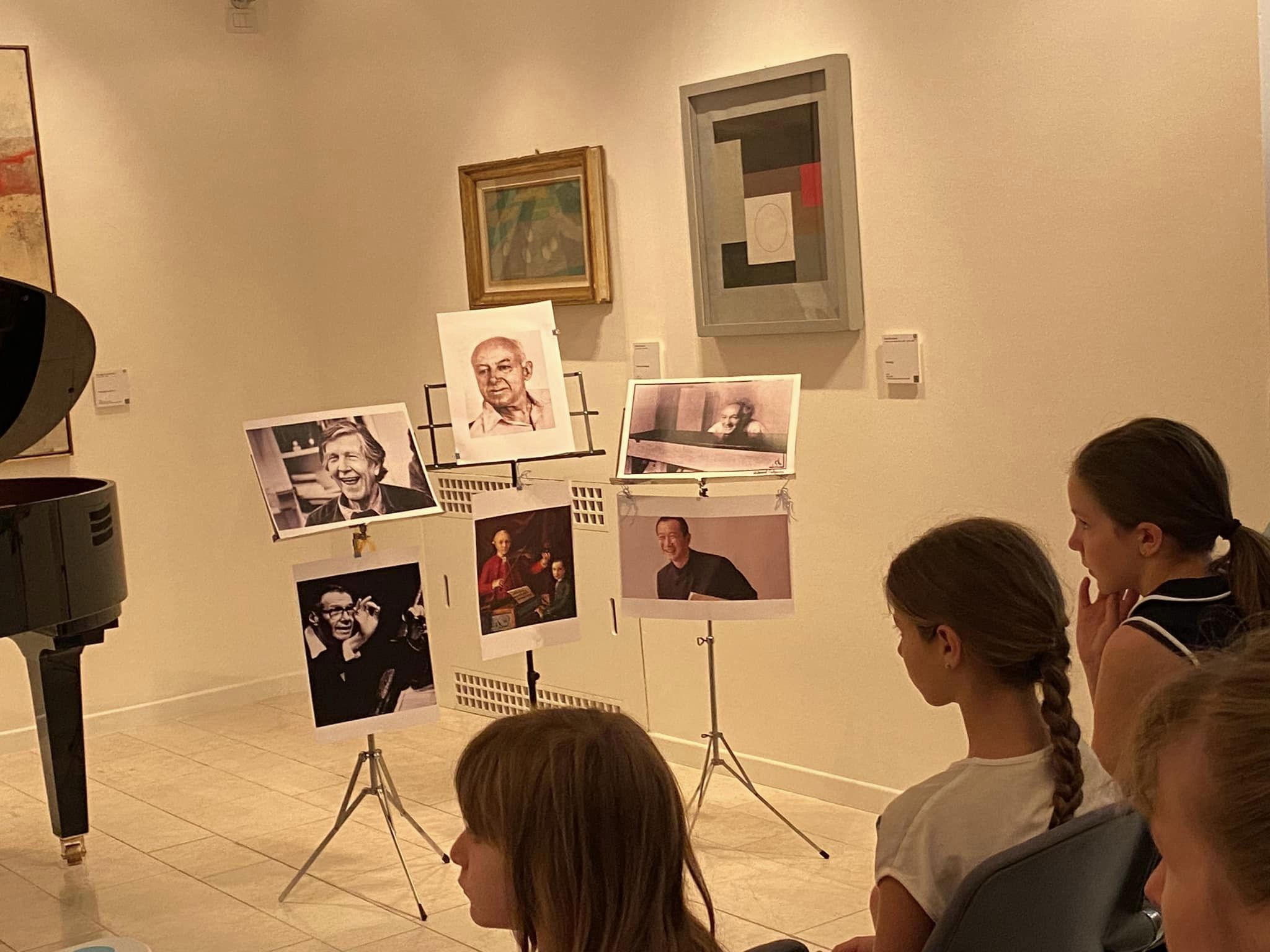
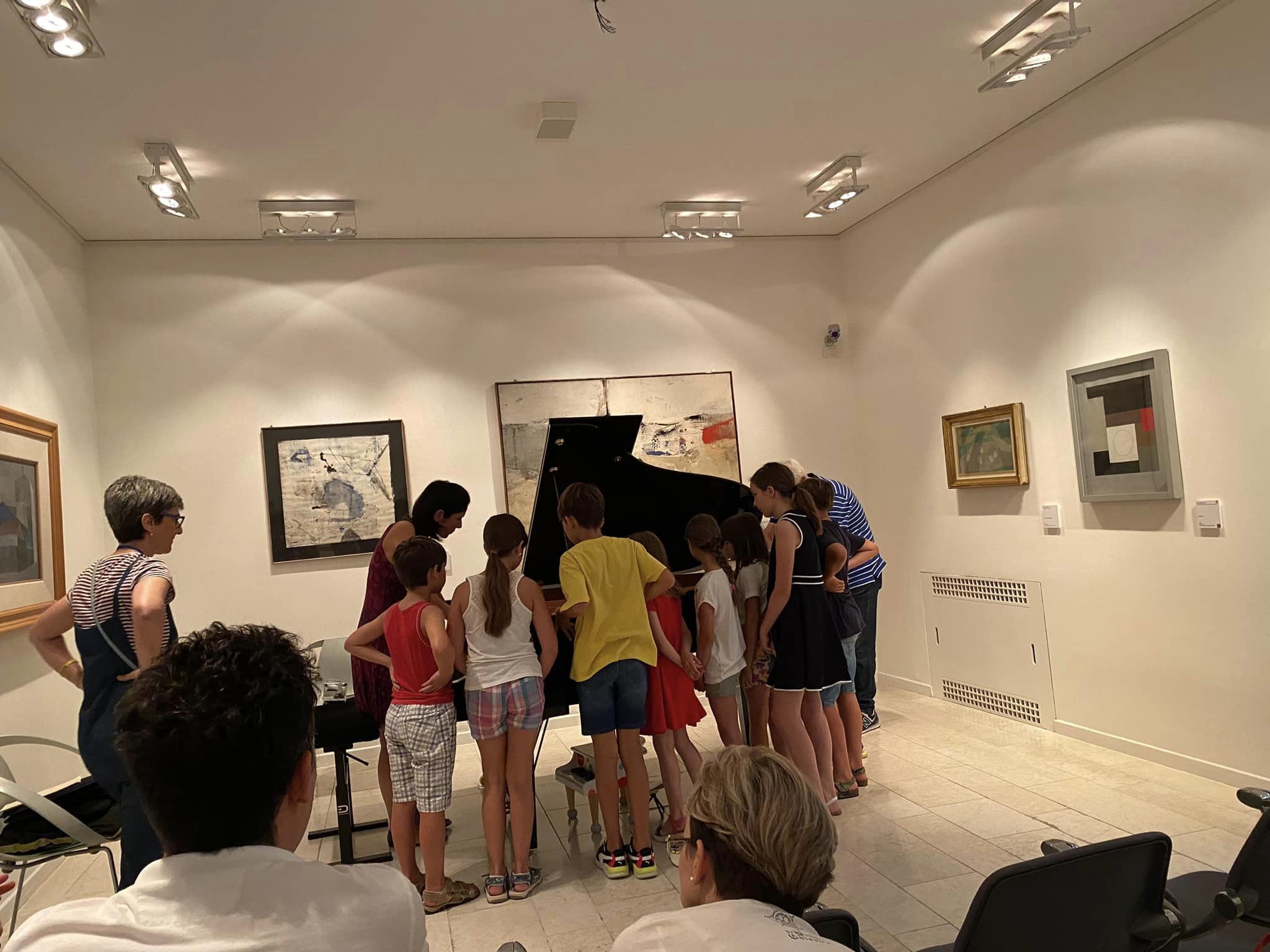
The invitation to this edition of the festival Udin&Jazz, titled “Jazz against the machine”, was an other tile of the mosaic. Having been asked to lead a concert for kids and families about contemporary/experimental music, I started reflecting upon the meaning of education, let’s say about the ingredients of such a fundamental task in human society that is growing the next generation – a task we are delegating more and more to entities not always emotionally connected to our children. I quote from the presentation:
Piano Maestro – How important is the role of the teacher in transmitting knowledge, in a humane society? In times that constantly mention so-called artificial intelligence, it is good to weigh the value of “showing how it is done, by doing.” A gesture that combines in-formation, care, passion, pleasure, meaning. The masters of this concert do not go slow, in truth, [“piano” in Italian means also “slow”, ed.] but they take great leaps and transform the piano into an instrument that is not yet there. Their students will go even further, making their own that look between the curious and the amazed that allows them to imagine, and realize, the world of their own desires.
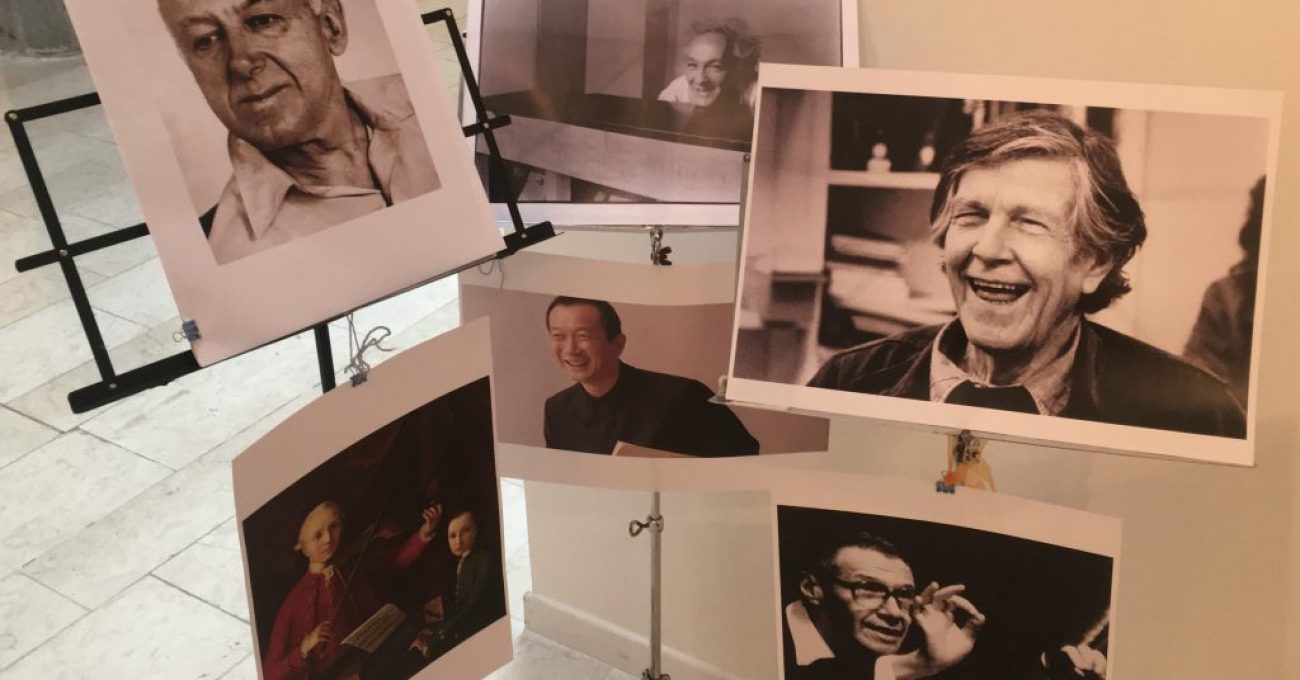
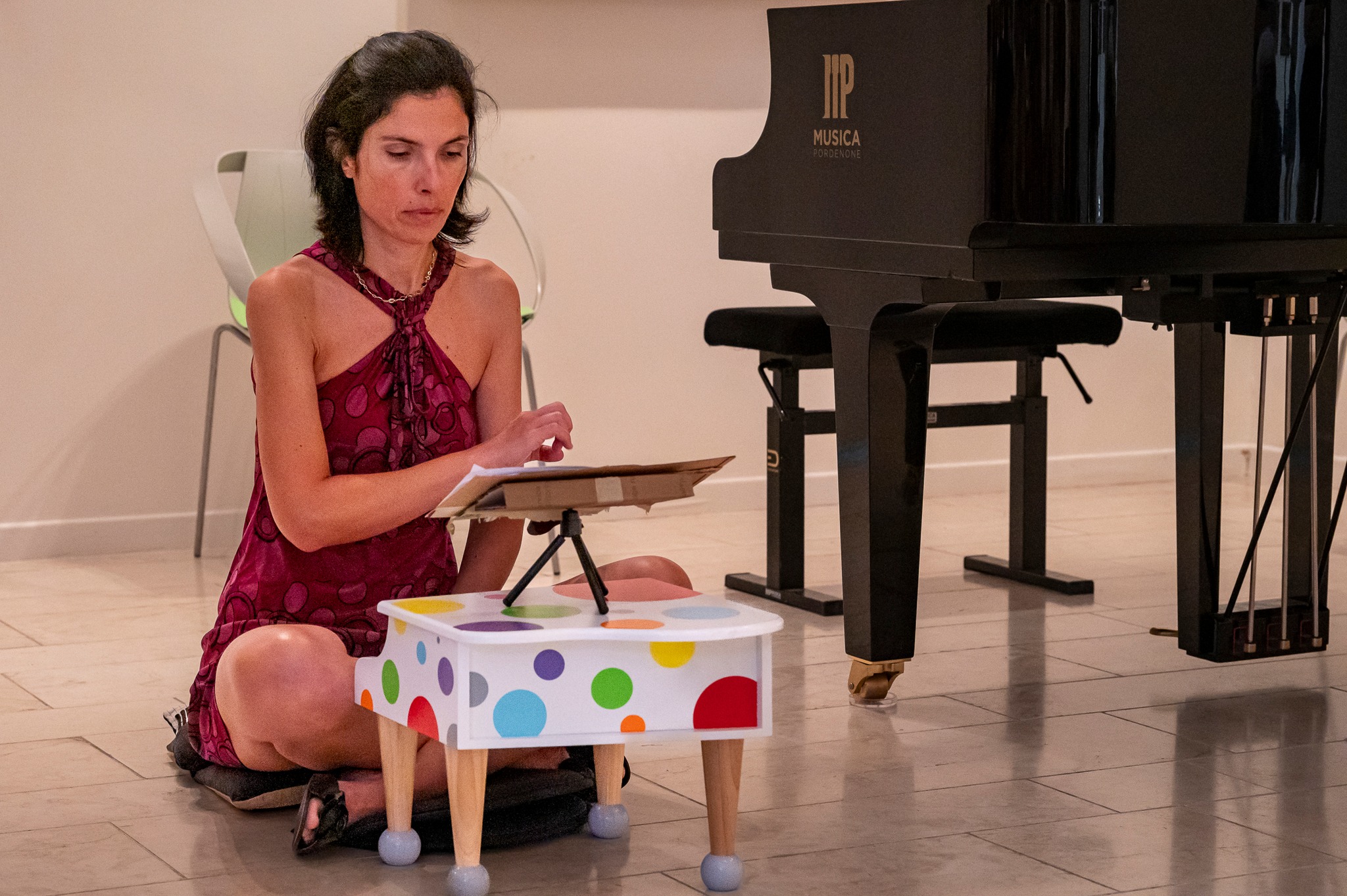
The music of Henry Cowell, John Cage, Philip Corner, Tan Dun, seemed to me a recognizable path of an attitude towards art and life that constitutes the real heritage from teacher to pupil. György Kurtág’s Játékok is a lovely example of the reverse process: the blessing of learning at every age from every cue that life brings to us (and every teacher knows how much he learns from his students!). Leopold and Wolfgang Amadeus made a brief, courteous apparition among all this ordeal of strange sounds. Looks like the kids enjoyed the performance, and the adults too. Thanks to Francesca Tini Brunozzi and Angelo Salvin for the pics below.
A couple of very nice reviews came from Germany this month: one on Glissando magazine about MaerzMusik performance in Berlin in March, the other published on the historical Schott music magazine Neue Zeitschrift fuer Musik (founded by Robert Schumann, it dates 1834).
Monika Zykla wrote an extensive review about all the events of MaerzMusik festival 2023 for magazine Glissando. That’s how she refers to Subtle Matters recital: “In the first part of the three-hour-long evening program titled Subtle Matters the Italian pianist and researcher, Agnese Toniutti, delivered a stunning solo piano recital that explored the sonic possibilities of the instrument „beyond its body” as described in the program. One of the highlights was Toniutti’s enthralling performance of Lucia Dlugoszewski’s four-part solo “timbre piano”4 composition, Exacerbated Subtlety Concert (Why Does a Woman Love a Man?) (1997/2000). This piece was juxtaposed with Tan Dun’s C-A-G-E, fingering for piano (1994), an homage to John Cage, and a selection of compositions for real and toy piano by the American composer Philip Corner. As in her solo album released in 2021 under the same title, Toniutti showed exceptional sensitivity and insight in her selection of the pieces. As a result, a fascinating dialogue emerged between Dlugoszewski and Dun’s compositions that further contextualized and situated Dlugoszewski’s music and aesthetics as part of the New York scene. It subtly referenced Dlugoszewski’s ambiguous and changing attitude towards John Cage as its most prominent and central figure which I read as a hint towards the question of why Cage’s silences were louder than the silences of others. Toniutti undertook an extensive body of research so that subtleties like this could surface and be signaled through music. Not to mention the amount of work she put into performing Dlugoszewski’s piece in the first place, despite the score being unavailable, as Toniutti explained in the program note.” You can read the complete article here.
Jakob Böttcher reviewed Sonatas and Interludes for prepared piano by John Cage, released this spring on Neuma Records, on Neue Zeitschrift fuer Musik issue 2/2023. Here is the English translation, and below the screenshot of the original review in German. “Screws and erasers – in view of the unbelievably rich sound palette that unfolds, it is hard to believe that these are the only objects that John Cage opposes to the sublime piano as preparation objects. Even Cage himself noted that the sound result of the preparations can vary greatly depending on the instrument. With her version of the opus magnum for prepared piano, composed in 1946-48, the Italian pianist Agnese Toniutti has succeeded in creating an incredibly high-resolution and subtle recording, both in terms of interpretation and sound. Cage certainly did not call the one-movement miniatures, most of which are barely three minutes long, Sonatas and Interludes without a hint of irony. The symmetrically nested 16 sonatas and four interludes follow in their arrangement and form a stringency that continues in the musical text in the form of idiosyncratically angular rhythms and patterns. Toniutti understands how to implement the often mechanical character of the pieces with emphasis (she herself writes in the booklet that she understands it as her role to implement especially the tone durations as precisely as possible) and yet to recognize and emphasize the humanity, even a cantabile gesture, that they contain. Her fine pianistic agogic delivers an authentic and at the same time organical result. A similar dualism is found on the tonal level. The musical text and the preparation go hand in hand. The preparation evokes the machine-like character, in which the piano mutates into a real sound apparatus through the screws and erasers. On many recordings, the piano is almost unrecognizable behind these drum-like, often wooden sounds. Agnese Toniutti’s preparation takes a different approach and refreshingly does not hide the sound generator; with many notes the piano tones are clearly recognizable. Paradoxical – and ingenious – is the fact that the preparation sounds are not drowned out by this, but can even be experienced all the more intensely. Thus, Toniutti’s piano is uniquely balanced in reproducing the preparations in an exceptionally wide range of colors (the screws are obviously carefully selected and placed) and at the same time combining them with the familiar tones of the concert grand. The keys are always softly struck, even in the most machine-like conditions, despite the considerable dynamic reduction due to the preparation, which – as Toniutti notes in the booklet – often tempts one to play with more weight. The soft attack underpins the tonal fusion of piano tone and preparation sound. The high sound quality of the recording (sound: Marco Melchior) contributes decisively to the tonal brilliance, which portrays the grand piano very directly and yet warmly and spatially. Agnese Toniutti has succeeded in making an excellent recording of the Sonatas and Interludes, in which she coherently and nuancedly balances machine-like and human agogic as well as preparation and piano sound. The sound result is unique.
It is a great satisfaction to be able to announce this new Spring release (street date: March 17th, 2023), coming out after many years of performances of such a masterpiece as Sonatas and Interludes for prepared piano by John Cage. This achievement was possible thanks to a great team of professionals: Marco Melchior, always by my side recording, Erdem Helvacioglu, mastering, and Philip Blackburn, director and manager of Neuma Records label.
To have a physical copy come listen to one of my concerts or buy it on Bandcamp or on Neuma Records website (also digital download).
…a fresh look into the seven decades old music that both her playing and her musicological insights make as fresh as if the work had been composed last year.Rafael de Acha, All about the Arts , February 27th, 2023
The prepared piano was one of the legacies of composer John Cage, and this album with Agnese Toniutti gives a tribute to the iconoclastic sound and attitude. Is the listener prepared for the prepared piano? George W.Harris, Jazz Weekly, February 27th, 2023
The sound of the work has something special, different from many other editions of this repertoire… we have reason to believe that Cage would have appreciated this magical playful “humus.” Needless to note Toniutti’s executive gracefulness, which blends with that precision of accent inescapable in the most “antipianistic” pianism of the 20th century, devoid of emphasis, restored to a welcoming, almost meditative dimension. Marco Maria Tosolini, Il Gazzettino, March 8th, 2023
Agnese Toniutti, among the greatest “performers” of contemporary classical music, interprets to perfection this summa of modern culture… And the pianist, in approaching the instrument, opts for the wonder of intonation and the delicacy of timbre. Guido Michelone, Alias – Il Manifesto, March 18th, 2023
Certainly there’s much to admire in the Italian pianist Agnese Toniutti’s centered rhythm, rich palette of dynamic nuances, and her sensitive textural delineation…Toniutti unquestionably conveys the music’s roots in dance, as well as Cage’s subtle humor. Her intelligent, well-written booklet notes discuss both the music and the process of getting it ready for performance.
Jed Distler, Classics Today.com, April 3rd, 2023
This is a very enjoyable recording whether it is to be a collector’s only recording of this music or one that stands most favorably in comparison to previous recordings. If this is to be your first recording of this work or if you simply want to hear another interpretation, you will not be disappointed. This is a wonderful performance. […] Keep your eyes and ears open for Agnese Toniutti, an advocate for and a master of the avant garde.
Allan J.Cronin, New Music Buff, April 14th, 2023
…That is why this interpretation by Toniutti is sensational. We are listening to a Martian instrument; the technologization of the old piano is extreme and detected. Then there is the anti-solemn attitude of this performer who manages to bring to mind the amiability of Cage in the midst of games (also paradoxically evocative of the Baroque) that seem to take place among laboratory machines and not in front of the most matronly and bourgeois of keyboard instruments. Mario Gamba, Alias – Il Manifesto, April 22nd, 2023
From the booklet of Sonatas&Interludes, Neuma Records